
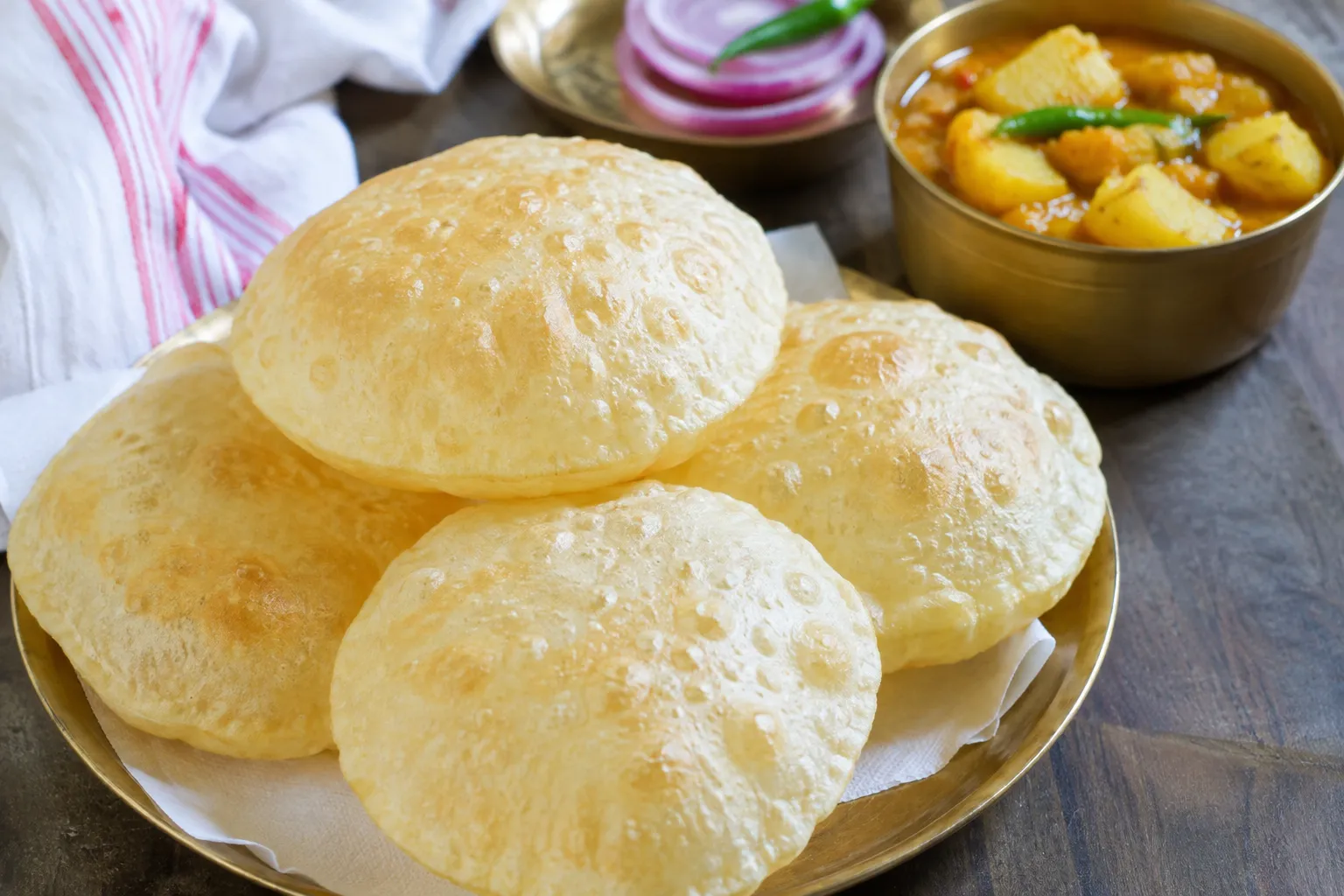
Luchi Recipe (Puffed Indian Fried Bread)
Poori is a classic Indian deep-fried flatbread made from whole wheat flour, water, and salt. When fried in hot oil, the dough expands rapidly, trapping steam inside to create a hollow, golden, and puffed sphere. It is a staple breakfast and festive dish across India, often paired with spiced potato curry or sweet halwa.
The key to a successful poori lies entirely in two factors: a stiff, low-moisture dough and the correct oil temperature. Getting these two details right prevents the bread from absorbing too much oil, ensuring it rises fully and stays light rather than turning heavy or greasy.
Why This Recipe Works
- A stiff dough absorbs significantly less oil during frying and provides the structure needed to trap steam and puff up.
- Adding a small spoonful of fine semolina (sooji) keeps the fried pooris puffed and crisp for longer after they are removed from the oil.
- Rolling the dough with a few drops of oil instead of dusting with dry flour keeps the frying oil clean and prevents burnt flour particles from sticking to the bread.
Ingredient Notes
- Atta (Indian whole wheat flour): This is a finely milled durum wheat flour. Western whole wheat flour is coarser and can yield dense pooris that fail to puff. If you cannot find atta, a mix of equal parts all-purpose flour and standard whole wheat flour is a practical alternative.
- Fine semolina (sooji): A small amount is recommended to add structural support, which prevents the poori from deflating immediately after frying.
- Frying oil: Use a neutral oil with a high smoke point, such as canola, sunflower, or vegetable oil. Avoid olive oil as its low smoke point is unsuitable for the high heat required.
If You’re Cooking Outside India
- Atta: Look for packages labeled chakki atta in Indian or South Asian grocery stores. If shopping in standard supermarkets, look for durum wheat flour or use a 50/50 mix of all-purpose flour and whole wheat flour.
- Fine semolina (sooji): If your local store only carries coarse semolina, grind it in a clean spice grinder or blender for 10 to 15 seconds to make it fine before adding to the dough.
How to Make Poori
Kneading a stiff dough
Combine flour, semolina, salt, and water to form a firm, tight dough. The dough must feel noticeably stiffer than roti or chapati dough.
Resting the dough
A short 15-minute rest allows the gluten to relax, making the stiff dough pliable enough to roll without tearing.
Rolling without flour
Divide the dough into equal portions and roll them out using a drop of oil instead of dry flour to preserve the frying oil.
Frying in hot oil
Slide the rolled disc into hot oil and gently press it with a slotted spoon to encourage even steam expansion and a complete puff.
Cooking Tips
- The dough must be tight. If you add too much water, the pooris will become soft, soggy, and absorb a lot of oil during frying.
- Do not roll the pooris too thin or too thick. If they are too thin like tortillas, they will turn into hard crisps without puffing. If too thick, the inside will remain raw and doughy.
- Test the oil temperature before frying. Drop a tiny piece of dough into the oil; it should sizzle and rise to the top instantly. If it sits at the bottom, the oil is too cold. If it darkens immediately, the oil is too hot.
Common Mistakes to Avoid
- Using dry flour to roll the pooris: The dry flour falls off into the hot oil, burns, and leaves dark, bitter specks on the subsequent pooris. Use a drop of oil on your rolling pin and board instead.
- Frying in lukewarm oil: If the oil temperature is too low, the dough will absorb oil like a sponge instead of puffing. Ensure the oil is steadily hot (around 190°C / 375°F) before sliding the first poori in.
- Not pressing down on the rising poori: If left untouched, the poori may puff only partially. Gently pressing the top of the rising dough with a slotted spoon forces steam into the edges, creating a full puff.
Variations
- Masala Poori: Add a pinch of turmeric, red chili powder, cumin powder, and carom seeds (ajwain) to the flour before kneading to create a spiced version.
- Palak Poori: Blanch fresh spinach leaves, puree them with ginger and green chilies, and use this puree instead of water to knead the dough for green, flavorful pooris.
Serving Suggestions
- Serve hot with classic potato curry (Aloo Bhaji or Jeera Aloo).
- Pair with chana masala (spiced chickpea curry) for a hearty weekend brunch.
- Serve alongside sweet suji halwa or shrikhand for a traditional sweet-and-savory meal combination.
Storage & Make-Ahead
Make ahead: The dough can be prepared up to 24 hours in advance. Wrap it tightly in plastic wrap and store in the refrigerator. Bring the dough back to room temperature before rolling and frying. Do not roll the pooris ahead of time, as they will dry out and fail to puff.
Refrigerate: Fried pooris are best eaten fresh. If you have leftovers, store them in an airtight container lined with paper towels in the refrigerator for up to 2 days.
Freeze: We do not recommend freezing fried pooris as they lose their delicate texture and become soggy upon thawing.
Reheat: Reheat leftover pooris on a warm, dry griddle or tawa over medium heat for 30 seconds on each side, or in an oven at 150°C (300°F) for 5 minutes. Avoid using a microwave, which makes them chewy.
Frequently Asked Questions
Why did my poori not puff up?
The two most common reasons are lukewarm frying oil and uneven rolling. If the oil is not hot enough, the dough cannot expand rapidly. If the poori is rolled unevenly or has a small hole, steam escapes instead of lifting the dough. Ensure your oil is steadily hot and roll with even, gentle pressure.
Can I make this recipe using regular whole wheat flour?
Yes, but because standard Western whole wheat flour is coarser, the texture will be denser and may not puff as easily. For the best result outside of India, blend equal parts of standard whole wheat flour and all-purpose flour to mimic Indian atta.
How do I stop the pooris from absorbing too much oil?
The secret to non-greasy pooris is a stiff dough. Adding too much water makes the dough soft, which causes it to soak up oil like a sponge. Always keep the dough firmer than standard flatbread dough and fry at a high, steady temperature.
More Indian Recipes to Try
Browse the IndiPlated recipe index
Poori
Ingredients
Equipment
Method
- In a large mixing bowl, whisk together the atta, fine semolina (if using), and salt until evenly combined.
- Drizzle 1 teaspoon of oil over the flour mixture and rub it in with your fingertips. Add water gradually in small splashes, mixing with your hand to bring the flour together.
- Knead the mixture into a tight, stiff dough. It should be significantly firmer than roti dough and not sticky at all. Avoid adding too much water; a tight dough is critical to prevent the bread from soaking up oil.
- Knead the dough for 3 to 4 minutes until it becomes relatively smooth. Cover the dough bowl with a damp cloth or plate and let it rest at room temperature for 15 minutes.
- Fill a deep pan or kadai with neutral oil to a depth of about 5 cm (2 inches). Set the pan over medium-high heat. The oil must be hot enough before frying begins.
- Uncover the rested dough and knead it briefly for 30 seconds. Divide the dough into 10 to 12 equal-sized portions. Roll each portion between your palms to form a smooth ball, then flatten it slightly.
- Apply a drop of oil to your rolling board and rolling pin. Do not use dry flour. Roll a dough ball into an even circle of about 7 to 8 cm (3 inches) in diameter. Ensure the thickness is uniform; rolling too thin will prevent it from puffing, and too thick will leave the inside doughy.
- Drop a tiny pinch of dough into the hot oil. If it immediately sizzles, rises to the surface, and expands, the oil is ready. If it sinks and stays at the bottom, heat the oil for another minute and test again.
- Gently slide one rolled dough disc into the hot oil from the side of the pan to avoid splashing. Within 2 to 3 seconds, the poori will rise to the surface.
- As soon as the poori rises, use the back of your slotted spoon to gently press down on the center of the dough in a light, circular motion. This encourages steam to expand inside and puff the bread into a balloon.
- Once fully puffed, carefully flip the poori over. Fry the second side for 15 to 20 seconds until it turns a light golden-brown. Lift the poori out using the slotted spoon, hold it against the side of the pan for a moment to drain excess oil, and transfer to a plate lined with paper towels. Repeat the process for the remaining dough balls.
Notes
For best results, fry pooris one at a time to ensure the oil temperature does not drop.


3 Comments